10 Best Carbon Steel Mesh Types for Industrial Use
Carbon Steel Mesh is a practical choice for screening, filtration, guarding, and material handling. Its appeal is straightforward: steel wire can be woven or welded into openings suited to specific tasks. Yet “mesh” is not one product. Wire diameter, aperture size, weave, coating, and fabrication all affect performance.
The market context is substantial. World Steel Association’s October 2024 Short Range Outlook estimated global steel demand at 1,751 million tonnes in 2024 and projected 1,772 million tonnes for 2025. These figures describe steel demand overall, not mesh sales. That distinction matters. They show the scale of steel use, but cannot determine which mesh suits a plant’s process.
This guide examines ten industrial types, from plain-weave and twill-weave wire cloth to welded, expanded, and perforated forms. Each has trade-offs. Fine openings can improve particle separation, while heavier wires may better tolerate impact and handling. Corrosion resistance depends on the environment and any protective finish; carbon steel should not be assumed suitable for every wet or corrosive setting. ASTM E2016, the specification for industrial woven wire cloth, offers a useful reference for woven products, though it does not cover every mesh construction. Compare opening size, wire gauge, load, and cleaning needs before choosing. Small details count. And specifications alone cannot replace a real-world fit check.
Carbon Steel Mesh Basics: Aperture, Wire Diameter, and Open-Area Data
Carbon steel mesh selection starts with three measurements: aperture, wire diameter, and open area. Aperture is the clear distance between neighboring wires, not the center-to-center spacing. Wire diameter describes the thickness of each wire. Small differences matter. A caliper can check wire thickness, while a magnifier or optical gauge helps verify openings on a sample.
For square woven mesh, open area is the percentage of the sheet occupied by openings. A useful estimate is (aperture ÷ [aperture + wire diameter])² × 100. For example, a 1 mm aperture with 0.5 mm wire gives about 44% open area. This formula assumes a regular square weave; other patterns need different calculations. Measure twice.
More open area can improve airflow, drainage, or material passage, but it leaves less metal to carry load. Thicker wires usually add strength and wear resistance, while reducing the opening or open-area percentage. In practice, a drawing should state clear aperture and wire diameter separately. Mesh count alone can be ambiguous, especially when units or measurement conventions are missing. That detail is easy to overlook. Check the finished mesh against the intended duty and environment, since carbon steel can corrode when exposed to moisture without suitable protection.
Ten Mesh Types by Fabrication: Welded, Woven, Expanded, and Perforated
Carbon steel mesh is not one product. Its fabrication shapes strength, open area, and how easily material passes through. World Steel Association’s World Steel in Figures 2025 reports 1,882.6 million tonnes of crude steel produced worldwide in 2024. That scale matters: consistent fabrication and clear specifications are essential when mesh is selected for demanding industrial work.
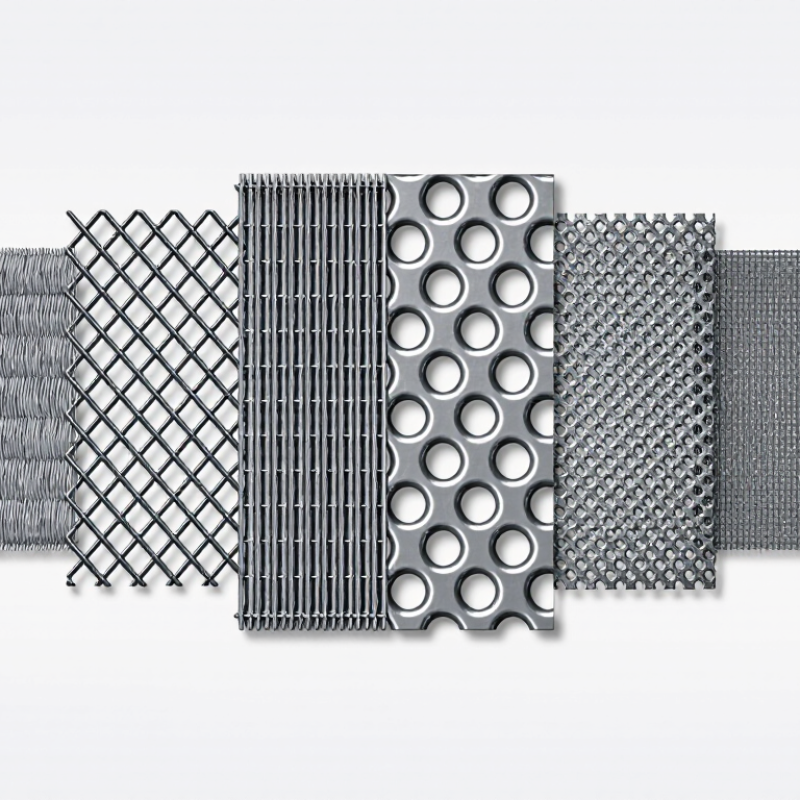
Welded square mesh holds its shape under load; rectangular openings can favor directional screening. Heavy-gauge welded reinforcing mesh suits concrete work, though handling weight rises quickly. Woven plain-weave mesh offers balanced openings for general screening. Twill weave accommodates thicker wires and finer filtration, while Dutch weave uses dense wires to retain smaller particles. ASTM E2016 covers industrial woven wire cloth.
Small detail. Big consequence.
Confirm aperture and wire diameter, not mesh count alone. Expanded raised mesh is cut and stretched from sheet, creating stiff, non-slip panels with open diamond shapes. Flattened expanded mesh has a smoother profile, useful where equipment or materials must pass over it. Perforated round-hole sheet supports regular drainage and airflow; slotted perforations can prioritize flow in one direction. These last two are often grouped with mesh, although they are sheet products.
One caveat: open-area percentages can mislead if thickness and hole dimensions are omitted. A practical specification should state steel grade, opening size, wire or sheet thickness, finish, and tolerance. Check ASTM E2016 or ISO 9044 where woven-cloth tolerances apply.
Material Benchmarks: ASTM A1064 Wire and A36’s 36-ksi Minimum Yield
ASTM A1064/A1064M covers carbon-steel wire and welded wire reinforcement, including plain and deformed forms. It is the more direct reference when evaluating mesh made from welded steel wire. Check wire diameter, spacing, weld condition, and required mechanical properties against the applicable specification and project drawings. At a cut panel edge, uneven spacing or a loose intersection can matter as much as a nominal grade. Small details count.
ASTM A36, by contrast, is a structural carbon-steel specification commonly used for shapes, plates, and bars; it is not a wire-mesh grade. Its 36-ksi minimum yield strength applies within specified product and thickness limits, so verify the mill test report rather than carrying that number over to mesh. A36 stock may support frames or edge members, while A1064 wire forms the welded grid. They serve different roles. Compare certified test data, dimensions, and intended loading before substitution. Ranking both materials by yield strength alone is a tempting shortcut, but it misses weld performance, wire geometry, and load direction. It is worth checking twice.
Industrial Performance: Load Capacity, Filtration, Abrasion, and Corrosion
Industrial carbon steel mesh performs differently under pressure, vibration, and abrasive contact. Welded mesh holds its shape well in guards, partitions, and support panels. Its load capacity depends on wire diameter, spacing, weld quality, and how firmly the edges are supported. A thick wire grid can still sag if its frame is too light. Fit matters.
Woven mesh offers smaller openings for screening and filtration, but fine wires may deform under heavy loads. Expanded mesh has continuous strands, which can provide useful rigidity without welded intersections. For abrasive service, thicker wires usually last longer, though they may reduce open area and flow. That trade-off is easy to overlook. Abrasion tests using the actual material can reveal wear that a specification sheet misses.
Corrosion remains a key limitation of untreated carbon steel, especially around moisture, salts, or cleaning chemicals. Galvanized or painted finishes can slow rust, but damaged edges and cut wires may corrode first. Inspect those spots after installation. Even a protective finish may not suit every process environment. Mesh selection should account for load, opening size, wear, exposure, and maintenance access together. A neat catalog table can still mislead; operating conditions are often less tidy.
Selection Checks: Opening Tolerance, Coating, and Standard Compliance
Carbon steel mesh selection depends on how closely the finished openings match the drawing. Check both aperture size and wire diameter, not just the nominal mesh count. Woven mesh can vary slightly where wires cross; welded mesh may show spacing changes near welds. Expanded mesh has different dimensions because its strands and openings are formed from one sheet. Measure several areas, including near the edges. A single reading can mislead.
Ask the supplier to state the permitted opening tolerance and how it is measured. Compare that figure with the size of particles or components the mesh must retain. Then inspect the coating specification. Galvanized, painted, and uncoated mesh behave differently in damp, abrasive, or high-temperature settings. Coating thickness can also affect clear openings, so confirm whether dimensions refer to the bare mesh or finished product. Small detail. Big difference.
Standards matter, but the reference must fit the product and application. Check the standard’s scope, edition, and test method; a certificate alone may not confirm every relevant measurement. Request a material certificate, inspection results, and traceability details where the project requires them. It is easy to over-specify a mesh on paper. A brief review with the fabricator can reveal whether the tolerance and coating are practical for the intended service.